My aunt (my mother's sister), who is now nearly 90 years old, never spoke about her experience of the atomic bombing of Hiroshima until about 20 years ago. My mother's family lived in Kure City, near Hiroshima City, during the war, and my aunt was on a train that stopped at Hiroshima Station on the morning of August 6, 1945. I recently noticed that there is a tendency among Japanese Americans in Los Angeles to not talk about their wartime experiences, just like my family in Kure, Hiroshima Prefecture.
It all started with an invitation to an art exhibition held at El Camino College in Torrance, a suburb of Los Angeles, in May 2014. The federal and local governments in the United States were running a campaign to focus on Asian Americans in May, and El Camino College held a one-month art exhibition in the library.
The work selected for the Asian American themed exhibition was the "EO 9066" series by Hatsuko Mary Higuchi (75 years old), a Sansei born in Los Angeles. EO 9066 refers to Executive Order 9066, the 1942 order by President Roosevelt to intern Japanese Americans.
Higuchi was born in Los Angeles in 1939 to a first-generation Japanese father from Wakayama Prefecture and a second-generation Japanese mother born in Santa Monica and educated in Wakayama Prefecture. She was named Hatsuko because she was the first child. Higuchi spent the years between the ages of three and six with her parents in an internment camp in Poston, Arizona. Her two younger sisters and brother were born in the camp.
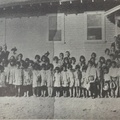
At the El Camino College exhibition, the latest work in the "EO 9066" series, "Non-Alien Nursery School" (watercolor, 22" x 30"), was on display at the entrance to the venue. During the war, the term "non-alien" was used to mean that Japanese-American children born in America were not foreigners (aliens).
Hatsuko Mary Higuchi's watercolor painting "EO 9066 Series, Non-Foreign Nursery School" is on display at the library of El Camino College in Torrance, near Los Angeles. The painting depicts the Poston Internment Camp (Arizona), where Higuchi spent the years of her life from age three to six. (Photo courtesy of Cultural News)
Higuchi, who was between three and six years old when he spent time in the internment camp, has no memory of it. After leaving the camp, the Higuchi family returned to Los Angeles and in 1951 purchased 10 acres of farmland near what is now Los Angeles Airport. However, shortly after making the down payment on the loan to purchase the land, Higuchi's father died at the age of 45. Higuchi's mother, who was 35 at the time, farmed and managed the remaining farmland alone and paid off the loan.
Higuchi's mother never spoke to Higuchi about her time at the Poston internment camp. "Non-Foreigner Daycare Center" is a reproduction of a photo that Higuchi found in 2014 among the photographs her mother left behind after she died in 2008. Higuchi has no memory of ever hearing about her experience at the Poston internment camp from her father, who died when Higuchi was 12 years old.
Higuchi graduated from Torrance High School, a school with a predominantly white student body, in 1957 and entered UCLA. According to Higuchi, at the time, teaching was the only job available for women, so she obtained her teaching qualification at UCLA. She worked as an elementary school teacher in the Torrance School District (equivalent to the Board of Education) from 1962 until her retirement in 2003. Higuchi was always a role model, even among the white students, being elected president of the girls' student council in high school and being chosen as "Homecoming Queen" at UCLA, where the majority of students were white at the time.
It wasn't until the 1980s, when Higuchi was in his 40s, that he found out that he had been in the Poston Internment Camp as a child. At the time, a movement for compensation for wartime internment of Japanese Americans was underway among Japanese Americans, and the internment camps were featured in newspapers. However, Higuchi never took the initiative to ask his mother about her experiences at the Poston Internment Camp. Higuchi explains that this was because she was busy with work and raising her children.
Higuchi first visited the site of the Japanese internment camp in 1998 when he participated in the Manzanar Paint Outs, which was started by Los Angeles painter Henry Fukuhara. Fukuhara is a second-generation Japanese immigrant from Los Angeles who was interned at Manzanar during the war. Fukuhara, who became a successful contemporary artist, was 85 years old when he started the Manzanar Paint Outs. Fukuhara did not tell the participating artists about his experience in the internment camp, nor did he criticize the US government.
Fukuhara passed away in 2010, but the event, where people gather and paint at the site of the Manzanar internment camp, has seen an increase in participants every year, and is now an annual event that gathers more than 100 people from all over the United States on the third weekend of May every year. What's more, the majority of participants are white. Higuchi began to paint the "EO9006 Series" while participating in the Manzanar Paint Out.
In October 2004, Higuchi took his mother, who was 88 years old at the time, to a reunion of Poston internment camp survivors held in Laughlin, Nevada. After the reunion, they returned home and Higuchi asked his mother about her experiences in the camp, but she still wouldn't answer. Higuchi's mother just kept repeating, "I don't want to talk about it." So Higuchi handed her a piece of paper and asked her to write down her thoughts. Higuchi's mother wrote, "I was always worried about my children's future." Reading this, Higuchi learned for the first time what his mother had thought in the internment camp.
© 2014 Shigeharu Higashi