Discover Nikkei Logo

https://www.discovernikkei.org/en/interviews/clips/1260/

Her grandfather and Dr. Thompson

Oh, yeah. Sure I was happy. Oh, I said, free, free.

So we’re going back to our house. The weeds are up so high. But you know, we took grandpa with us. Grandpa was still living. And you know, so we put him in the back seat and I was taking care of him. And when we get home there was that kind of a beautiful orangey colored roses blooming. So I cut that and put it by his bedside. And he said, "oh, that’s beautiful," he says, "Kirei dane." "Grandfather, what you have planted." And he just nods his head.

And then, in the meantime, Dr. Thompson, who was a wonderful doctor. He was a German doctor. He’s the one that has built this Burbank hospital. It’s a small hospital. And that’s where he kept my grandpa and my grandmother when we went to camp. In the basement. He had them there. He said, I’ll take care of them.

And then somehow the army found out that they were there. They come to Dr. Thompson. They come with the rifles and the guns, just an army of people. “You have enemy aliens down here.” So they come there, and he said, oh, he felt so bad, but then they took them away.

But Dr. Thompson was wonderful. When we came back out from camp and grandpa died at home, he even got everything all prepared with the other mortuary in North Hollywood. He took care of all that funeral for my grandfather. The casket, got us flowers. Everything. So really, really grateful, Dr. Thompson.


discrimination families grandfathers grandparents interpersonal relations parents postwar World War II

Date: May 24, 2011

Location: California, US

Interviewer: John Esaki

Contributed by: Watase Media Arts Center, Japanese American National Museum
Interviewee Bio

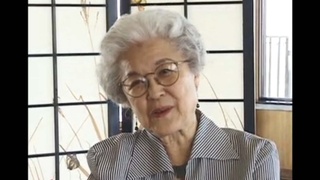
Sumiko Kozawa was born in 1916 in Los Angeles. The oldest of five children, Sumi spent three years in Japan before World War II, learning koto, flower arranging, and tea ceremony. Her family’s flower shop, Tokio Florist in Silver Lake, was popular with the Hollywood community because of its fresh flowers and reasonable prices. Sumi not only helped out, but also had the opportunity to meet many people, including famous silent movie star, Greta Garbo. When Japan bombed Pearl Harbor, Sumi and her family were sent to Manzanar. There she helped care for the family, taking care of her grandfather and younger sister. She passed away on December 2016, at age 100. (December 2016)

Peggie Nishimura Bain
en
ja
es
pt
Peggie Nishimura Bain

Response to loyalty questionnaire

(b.1909) Nisei from Washington. Incarcerated at Tule Lake and Minidoka during WWII. Resettled in Chicago after WWII

en
ja
es
pt
Peggie Nishimura Bain
en
ja
es
pt
Peggie Nishimura Bain

Difficulties finding apartment in Chicago after leaving Minidoka

(b.1909) Nisei from Washington. Incarcerated at Tule Lake and Minidoka during WWII. Resettled in Chicago after WWII

en
ja
es
pt
Richard Kosaki
en
ja
es
pt
Richard Kosaki

Under suspicion after Pearl Harbor

(b. 1924) Political scientist, educator, and administrator from Hawai`i

en
ja
es
pt
Richard Kosaki
en
ja
es
pt
Richard Kosaki

Change in attitudes after World War II

(b. 1924) Political scientist, educator, and administrator from Hawai`i

en
ja
es
pt
Art Shibayama
en
ja
es
pt
Art Shibayama

Thoughts on the post-9/11 atmosphere in the U.S.

(1930-2018) Nisei born in Peru. Taken to the United States during WWII.

en
ja
es
pt
Roger Shimomura
en
ja
es
pt
Roger Shimomura

Grandfather's arrival in the U.S., experiencing discrimination

(b. 1939) Japanese American painter, printmaker & professor

en
ja
es
pt
Roger Shimomura
en
ja
es
pt
Roger Shimomura

Dealing with racism within army unit in Korea

(b. 1939) Japanese American painter, printmaker & professor

en
ja
es
pt
Roger Shimomura
en
ja
es
pt
Roger Shimomura

Collection of artifacts depicting racial stereotypes influences art

(b. 1939) Japanese American painter, printmaker & professor

en
ja
es
pt
Frank Yamasaki
en
ja
es
pt
Frank Yamasaki

Encountering racial discrimination at a public swimming pool

(b. 1923) Nisei from Washington. Resisted draft during WWII.

en
ja
es
pt
Frank Yamasaki
en
ja
es
pt
Frank Yamasaki

Loss of happy-go-lucky adolescence in Puyallup Assembly Center

(b. 1923) Nisei from Washington. Resisted draft during WWII.

en
ja
es
pt
Frank Yamasaki
en
ja
es
pt
Frank Yamasaki

Memories of dusty conditions at Minidoka incarceration camp

(b. 1923) Nisei from Washington. Resisted draft during WWII.

en
ja
es
pt
Frank Yamasaki
en
ja
es
pt
Frank Yamasaki

Making the decision to resist the draft

(b. 1923) Nisei from Washington. Resisted draft during WWII.

en
ja
es
pt
Fred Sasaki
en
ja
es
pt
Fred Sasaki

Anti-Japanese sentiment at the time of World War II

(b. 1918) Issei businessman in Canada

en
ja
es
pt
Pat Adachi
en
ja
es
pt
Pat Adachi

Relationship with my father

(b. 1920) Incarcerated during World War II. Active member of the Japanese Canadian community

en
ja
es
pt
Kimi Wakabayashi
en
ja
es
pt
Kimi Wakabayashi

Arranged marriage

(b.1912) Japanese Canadian Issei. Immigrated with husband to Canada in 1931

en
ja
es
pt

Discover Nikkei Updates

NIKKEI CHRONICLES #14
Nikkei Family 2: Remembering Roots, Leaving Legacies
Read the stories and give a star to the ones you like the most! Help select our Community Favorite.
Vote for Nima-kai Favorite!
VIRTUAL PROGRAM
Nikkei Uncovered V: a poetry reading
Tuesday, December 9
Hosted by traci kato-kiriyama
Featuring Aaron Caycedo-Kimura, Erica Isomura, and Syd Westley
SUPPORT THE PROJECT
Discover Nikkei’s 20 for 20 campaign celebrates our first 20 years and jumpstarts our next 20. Learn more and donate!