It takes Gen some time to calm Tom down. After all, I, his enemy, have taken over his grill. It doesn’t matter whether you are from Hiroshima, Japan, or Harlem, New York City. No chef should invade another chef’s cooking space, even if it’s outdoors in the middle of a food festival.
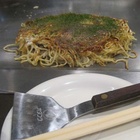
“Maybe I should stop,” I say to Risa, as I flip over another okonomiyaki.
“Are you kidding me? Look at the line. If you don’t give these people what they want, we’ll really be in trouble.” Risa returns to chopping another head of cabbage. Her art skills come in handy; the cabbage is thinly sliced to perfection.
Gen finally shakes a plastic bag filled with food tickets in Tom’s face. “This is what we’ve made so far in less than an hour.”
Tom is genuinely surprised. He turns away as if he is mad and walks toward the peach cobbler tent.
“Tamio-san,” Gen calls out to him.
Tamio, I think, that’s a Japanese name. How kawaii. Maybe this Gen and Tom are lovers and Tamio is Gen’s pet name for him.
“Keep going,” Risa hisses, a mountain of chopped cabbage growing in front of her.
After an hour, the crowd finally clears out. The festival is coming to an end, and Tom is nowhere to be seen.
“You know, I think I did a bad thing,” I tell Gen. “This was Tom’s booth, not mine. I had no business taking over while he was gone. I really created an imposition.”
“No, no, no.” Gen bags up the trash. “This was all my doing. And if Tamio gets mad, he can get mad at me. I’ll take the blame. But when I exchange the tickets into cash, he’ll change his mind.” Risa takes the trash from him and walks over to the dumpster. While he goes to exchange the tickets, I clean the grill. It was something my father had taught me. No matter how tired you may be from a long day of cooking, never leave the grill dirty.
“Soul food from Japan, huh?” Tom holds the makeshift promotional sign that Risa had created.
“Ah.” I immediately stop scrubbing. “Ah, I want to tell you that I am sorry. Very sorry.”
“Gen told me that it was all his idea. That he practically forced you to make some for him.” Tom gestured to Gen and Risa who were talking to other festival participants by the main tent.
“But still. I should have said no.”
He then pulls a stack of dollar bills from his apron pocket. “Here’s your share of the money. From the oki-doki or whatever you were making.”
I stop myself from correcting him. “No, no. I can’t accept.”
“Yes, you can.” He grabs my hand and places the money in it.
His hands are rough, callused and dry from working with food. I can relate. “At least eat some. You haven’t tried it.” I bring over a plate with a quarter slice of my last okonomiyaki. It’s slathered with mayonnaise and the tonkatsu sauce.
Tom frowns a little but he does try it. “Damn. That’s good. Lots of texture with the cabbage. And that sauce with the mayonnaise goes good together.” He chews slowly and I notice that his lips look pretty luscious. Wait! What am I saying? I really have lost my mind. I keep going: “I like your friend, Gen. It’s cute that he calls you Tamio.” Tom then just glares at me. “You know, a Japanese nickname.”
“It’s not a nickname.” He takes a deep breath. “That’s my real name. And Gen isn’t my friend. He’s my half-brother.”
“Ah, ah—” I don’t know what to say. I’m so confused. “But you hate Japan!”
“I do,” he says, his voice taking on a wistful tone, as if he has no other choice.
The torn pieces of Tamio’s life are starting to come together. Tamio has a Japanese parent. But that parent must have been absent from his life.
“You can’t hate Japan because you are Japanese yourself.”
“You see. My problem.” Tamio actually smiles, making him actually look handsome.
I have a thousand of questions, but I know that it’s not my place to interfere. I’ve already done enough damage.
“I hope that you don’t hate Japan more because of me. Because I don’t represent Japan well. I’m a troublemaker. Not a good person.” When I say it out loud and so directly in English, the weight of my actions hit me hard. Here I’ve been only worried about myself, not how I’ve inconvenienced my best friend, Risa, and now, a complete stranger. My parents would not be proud of my behavior. I’ve complained about the insensitivity of my uncle, but now I’m acting no better than him.
I take off the Deep Meats apron and fold it into a neat square. I present it to Tamio and then bow deeply. “Thank you for all you have done,” I tell him in Japanese even though I know that he doesn’t understand. “The past hour cooking has made me feel alive, more alive than I’ve ever felt since coming to New York.”
“Wait, what?” Tamio accepts the return of his apron but frowns.
Risa then runs over to us, her cell phone in her hand. “Kao-chan, you won’t believe it. Your uncle and cousin just arrived at JFK. And they are insisting to see you right away.”
© 2017 Naomi Hirahara